I learned to swim properly in my thirties. I certified as a technical diver in my late thirties. Those two facts sit at the front of this piece because they are the most useful thing I can tell anyone wondering whether the technical end of diving is open to them.
Starting late gave me something the naturals often lack. I had no inherited belief that water is safe. By the time I was any good in it, I was already reading accident reports for a living, in a manner of speaking, and every skill I have was built on purpose rather than absorbed as a child. Technical diving is procedural. It suits people who arrived at it deliberately.
What follows is what the disciplines actually ask of you, in the order I met them.
Technical diving: what changes past the recreational line
Technical diving begins where a direct swim to the surface stops being an option you can rely on. That happens two ways: depth that commits you to decompression stops, and a physical ceiling over your head. Both mean the dive has to be planned on land and executed as planned.
The change is arithmetic. Gas volumes, ascent rates, stop times, the mix you are breathing at each depth. A recreational diver can improvise. A technical diver who improvises is a technical diver having a bad day. Every hour of training I have done at this level was really training in doing the boring thing correctly while cold, narrowed and slightly behind schedule.
Cave diving is training in turning around
Caves are the least forgiving environment I have been in. There is no ascent. If your light fails and the water silts out, the only thing standing between you and a very bad outcome is a line you laid on the way in and your willingness to follow it out without arguing with it.
Cave protocol is unglamorous and worth stating plainly. You plan gas on the rule of thirds as a baseline: a third in, a third out, a third held back for the dive that goes wrong. Harder systems tighten that further, to fourths or sixths. You run a continuous guideline. You carry redundancy on every piece of life support, because a single point of failure in an overhead environment is a single point of drowning. You end the dive the moment reality stops matching the plan.
The divers I have watched last in caves share one habit. They call dives early and they do not apologise for it afterwards.
CCR: why expedition teams end up on rebreathers
A closed-circuit rebreather recycles the gas you exhale. It scrubs out the carbon dioxide, adds back the oxygen you used, and feeds it to you again. Two consequences follow, and both are why documentation teams gravitate to them.
The first is silence. Open-circuit diving fills the water with bubbles and noise, and animals respond to that. On a rebreather you are quiet enough that behaviour carries on around you rather than away from you. Anyone who has tried to film a wary animal on open circuit understands the difference immediately.
The second is runtime. Gas consumption on a rebreather is close to independent of depth, so a survey or a shot can be finished rather than abandoned at a turn pressure. That is the practical reason to accept the trade, and the trade is real: a rebreather is a life-support machine that requires pre-dive assembly, checklists, and a genuine understanding of what happens when the loop chemistry goes wrong. It gives you time in exchange for attention. Do not take one on if you are not prepared to give it the attention.
Extreme conditions: cold, current, and the ones nobody photographs
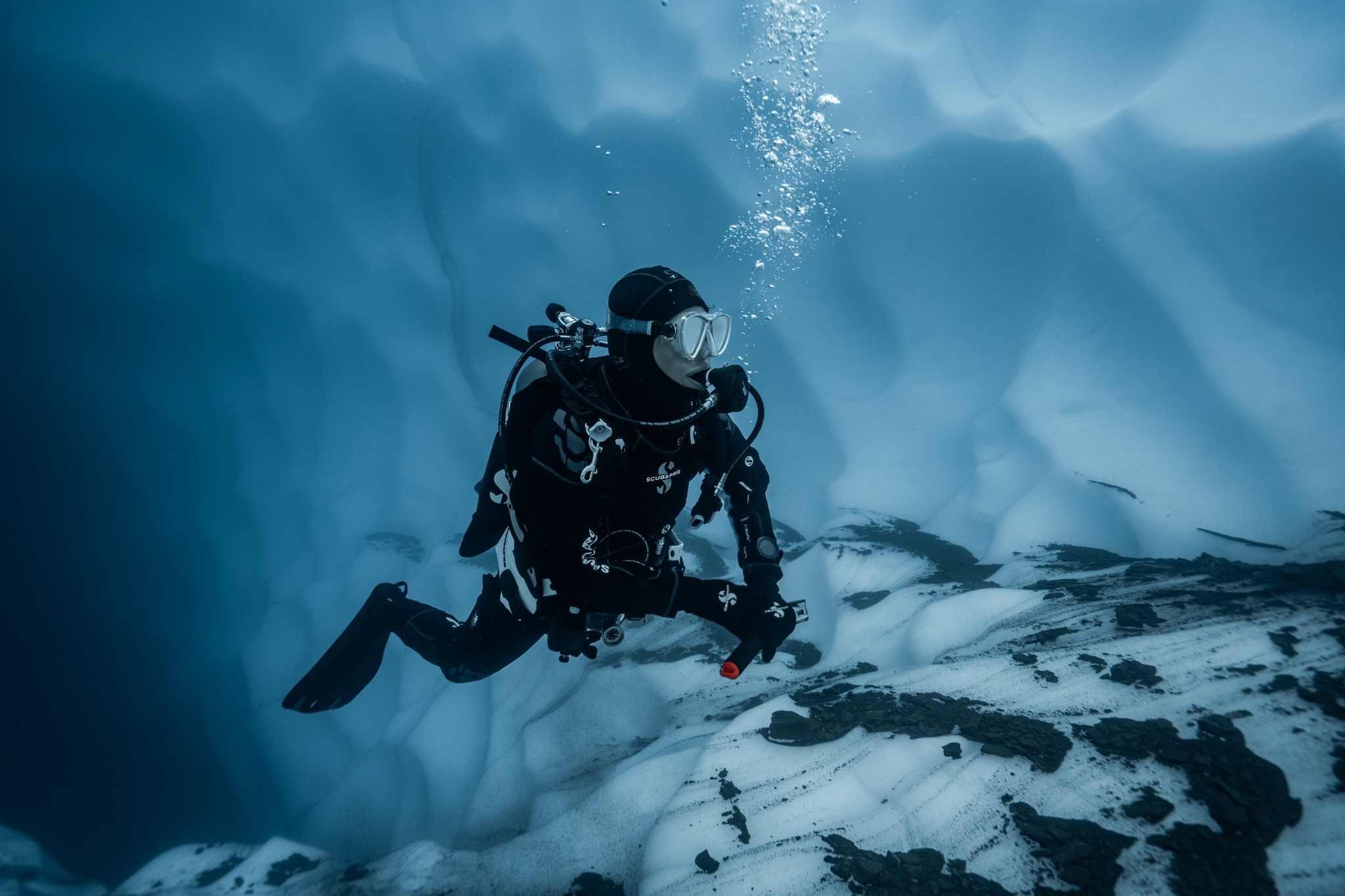
Under ice, the ceiling is solid and the exit is a hole you cut. The dives I have done run on a tether with a line handler topside and thermal redundancy, because cold water strips heat from you far faster than cold air. The real skill is managing gear that behaves differently near freezing, including regulators, which can free-flow near freezing whatever the label says, and far more readily if they are not cold-water rated.
The hardest diving I have done was not the deepest or the coldest. It was current, in open water, with nothing to hold. Drift technique, a surface marker you can actually deploy while being pulled, and a boat crew who know how to track and recover divers matter more than anything else in your kit that day. Current is the condition that finds out whether you have ever had to manage genuine fatigue mid-dive.
Women in expedition diving
I am asked regularly what is different about being a woman in this part of the sport, and there is one answer worth giving practically rather than politically: equipment fit, and who taught you.
Most technical kit was designed around a body that is not mine. A poorly fitted drysuit, a harness set for a longer torso, fins geared for a heavier leg: each of those shows up underwater as a trim problem, a gas-consumption problem, or a slow ascent you are fighting. Onlookers read all of that as a skill deficit. The cause is fit. Getting gear sized to you is not a comfort preference. It is a safety intervention and it changes how you dive within one dive.
The second half is instruction. Find teams and instructors who have trained women through these certifications before, because they will have solved the fit questions already and will not treat them as unusual. I hold Divemaster and Freediver certifications, and I was SSI ambassador from 2023-2026, the first brand ambassador they ever appointed, which has given me a look at how differently programmes handle this. The good ones are matter-of-fact about it.
Beyond that, my experience of expedition work is that the water does not care. The boat cares about whether you are useful, prepared, and honest about your limits.
If you want this, here is the honest path
Log hours in easier versions of the environment you want. Then log more. Train with people who have worked the exact conditions you are heading into, not adjacent ones. Buy fit before you buy features. Build a reason to be in the water beyond the diving itself, because research support, survey work and media are what put divers on expedition teams and keep them there.
Then get comfortable being the least experienced person on the boat for a long time. That was my position for most of three years across 53 countries, and it is the reason I learned anything at all.
Questions I get asked
Is it too late to become a technical diver in your thirties or forties?
No. I learned to swim properly in my thirties and certified technical in my late thirties. Starting late means you build the skill deliberately, with an adult's appetite for procedure and no inherited assumption that the water is safe. Technical diving rewards that. The people who struggle are the ones in a hurry.
What is CCR diving and why do expedition teams use it?
A closed-circuit rebreather recycles your exhaled gas, scrubs the carbon dioxide out of it and adds back the oxygen you consumed. You produce almost no bubbles and your gas lasts far longer than on open circuit. For documentation work that matters twice: quiet gear means animals behave normally around you, and long runtimes mean you can stay with a survey or a shot until it is actually finished.
What does cave diving require that open-water diving does not?
A direct route to the surface does not exist in a cave, so every system has to work without it. That means the rule of thirds for gas planning, a continuous guideline you can follow out in zero visibility, redundancy on every piece of life support, and the discipline to end a dive the moment the plan stops matching what is in front of you. Cave training is mostly training in turning around.
What certifications do you need for expedition diving work?
There is no single ticket. I hold Divemaster and Freediver certifications and I was SSI ambassador from 2023-2026, the first brand ambassador they ever appointed. What actually gets you onto expedition teams is logged hours in the specific conditions you are claiming, plus a documented reason for being in the water: research support, media, survey work. Certifications open the door. Field logs keep you in the room.
How do women get into technical and expedition diving?
The same way anyone does, with one practical difference worth naming: find instructors and teams who have trained women before, and get gear that fits you rather than gear you are adapting to. Poorly fitted equipment reads as a skill problem when it is a fit problem. Beyond that it is hours, honest self-assessment and a willingness to be the least experienced person in the boat for a long time.